
High-throughput pathogen removal from blood using margination
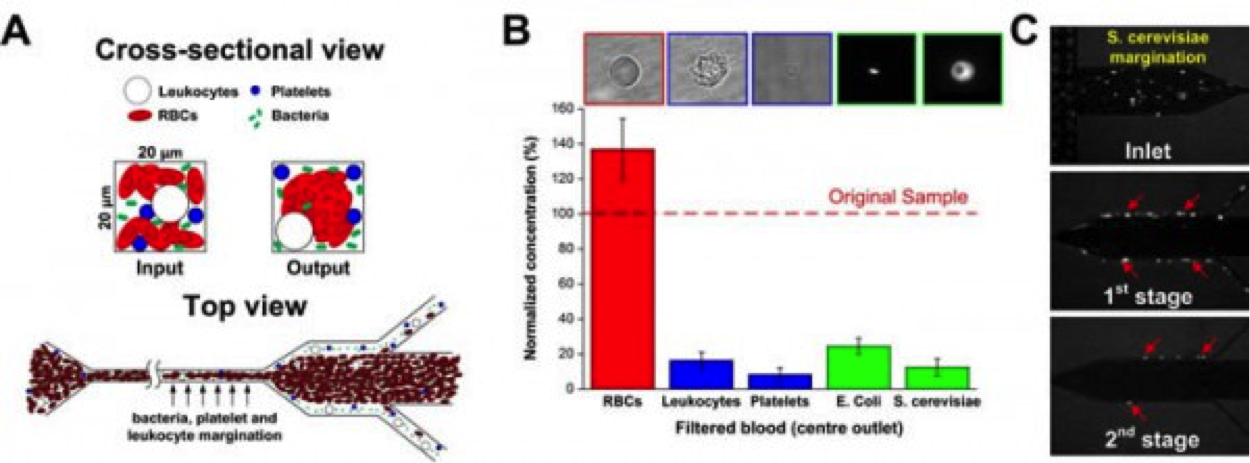
Sepsis is an adverse systemic inflammatory response caused by microbial infection in blood. In this work, we report a simple microfluidic approach for intrinsic, non-specific removal of both microbes and inflammatory cellular components (platelets and leukocytes) from whole blood, inspired by the in vivo phenomenon of leukocyte margination. As blood flows through a narrow microchannel (20 × 20 µm), deformable red blood cells (RBCs) migrate axially to the channel center, resulting in margination of other cell types (bacteria, platelets and leukocytes) towards the channel sides. As an application for sepsis treatment, we demonstrated separation of Escherichia coli and Saccharomyces cerevisiae from whole blood (>80% efficiency) using a 2-stage cascaded channel design. Inflammatory cellular components were also depleted by >80% in the filtered blood samples, which could help to modulate the host inflammatory response and potentially serve as a blood-cleansing method for sepsis treatment. The developed technique offers significant advantages including high throughput (~1mL/hr per channel) and label-free separation that allows non-specific removal of any blood-borne pathogens (bacteria and fungi). Due to design simplicity, further multiplexing is possible by channel parallelization or device stacking to achieve higher throughput comparable to convectional blood dialysis systems used in clinical settings.
References
1. Pantel, K., R.H. Brakenhoff, and B. Brandt, Detection, clinical relevance and specific biological properties of disseminating tumour cells. Nature Reviews Cancer, 2008. 8(5): p. 329-340.
2. Parkinson, D.R., et al., Considerations in the development of circulating tumor cell technology for clinical use. Journal of Translational Medicine, 2012. 10(1): p. 138.
3. Yu, M., et al., Circulating tumor cells: approaches to isolation and characterization. The Journal of Cell Biology, 2011. 192(3): p. 373-382.
4. Sun, Y.F., et al., Circulating tumor cells: advances in detection methods, biological issues, and clinical relevance. Journal of cancer research and clinical oncology, 2011: p. 1-23.
5. H. W. Hou, H. Y. Gan, A. A. S. Bhagat, L. D. Li, C. T. Lim, and J. Han, “A microfluidics approach towards high-throughput pathogen removal from blood using margination,” Biomicrofluidics, vol. 6, pp. 024115-13, 2012.